
Madison Parole and Probation
North Carolina uses three distinct forms of community supervision. Probation is ordered by a court and may replace all or part of active confinement. Parole is conditional early release under an older sentencing law, plus a limited modern category involving juvenile life sentences. Post-release supervision is the mandatory community phase tied to many current structured felony sentences. A Madison County person can therefore be outside the detention center or prison while still reporting to the North Carolina Department of Adult Correction, or NCDAC.
Ordinary pretrial bond terms are not probation. A pending court case, secured bond, unsecured bond, custody release, or electronic house arrest may place limits on a person without creating an NCDAC probation record. The signed Madison County court order identifies those terms. By contrast, an active probation, parole, or post-release entry should appear in the person’s state correctional history when the record is public and current.
| Supervision type | How it begins | What release means |
|---|---|---|
| Probation | A North Carolina court orders community supervision | The person may avoid or follow confinement, but remains bound by the judgment |
| Parole | The Parole Commission grants conditional release under an applicable parole law | Prison custody ends while supervision and possible revocation remain |
| Post-release supervision | A structured felony sentence reaches its prison-to-supervision point | The person leaves prison, but the sentence continues through supervision |
- Discharge
- Formal completion of the correctional supervision episode, not merely departure from a jail or prison.
- Revocation
- An official action that can return a supervised person to custody after a qualifying violation.
- Absconder
- A person alleged to have stopped complying with reporting or location requirements while supervision remains active.
Verify Madison Post-Release Supervision
The public starting point is the NCDAC Offender Public Information search. It covers North Carolina correctional involvement, not every person booked only in Madison County Detention Center. Use the seven-digit offender number when available. A name search can also use first and last name, middle initial, birth date or age range, race, sex, ethnic group, and a Sounds Like option. Compare enough details to avoid joining one person’s supervision record to another person with the same name.
- Select Active Probationer/Parolee to look for current community supervision. Use All if the present state is uncertain.
- Enter the offender number or the most precise name and birth details available. Review near matches rather than choosing by name alone.
- Open the correct detail and read the current status, supervision type, dates, offense history, and any listed supervision episode.
- Use the current Community Supervision office directory to locate the reporting office. Confirm the office before traveling.
- If the public entry is unclear, call Community Supervision. Staff may confirm reporting jurisdiction but can limit person-specific details.
An active supervision result establishes NCDAC control in the community. It does not prove every charge or sentence is over. For a county-only release with no state correctional record, use the Madison Sheriff release record and the court file instead. The broader custody workflow is set out on the Madison County released-inmate search.
Note: A blank state result can reflect a county-only case, a spelling problem, a different jurisdiction, or a record-access limit.
Madison Supervision Office Record
A July 2023 NCDAC directory places Madison County in Judicial District 24 and lists the local office in Mars Hill. The newer directory is the best researched contact, though directories can change. Older official resource sheets point to an office on Bridge Street in Marshall and disagree on phone numbers. Those older contacts should not override the dated directory. Call before appearing in person, especially when a reporting order names a different location.
Madison County office:
22 N. Main Street
Mars Hill, NC 28754
828-689-8967 or 828-689-8968
Fax: 828-689-8966
State division:
2020 Yonkers Road, MSC 4250
Raleigh, NC 27699-4250
919-716-3100
The District 24 management notice confirms that the supervision area includes Avery, Madison, Mitchell, Watauga, and Yancey counties. That regional structure explains why a Madison County record may refer to a district office rather than a county department.
The official Community Supervision overview describes the statewide division and its work. The image below comes from that NCDAC source.
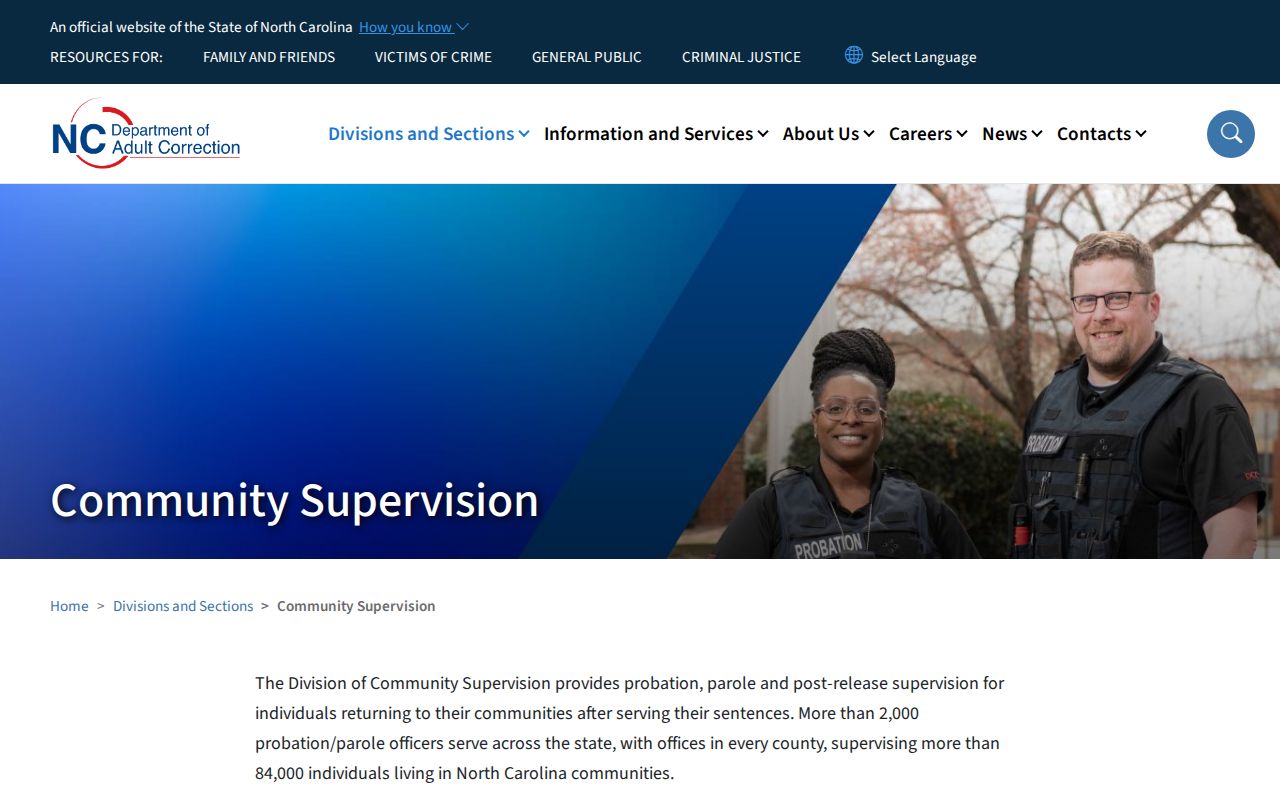
Use the statewide explanation for definitions, then use the dated directory and the person’s order to identify the actual Madison reporting location.
Madison Absconder Status Checks
The separate NCDAC Absconders search is the correct state path when a supervised person may have stopped reporting or cannot be located by the agency. An absconder entry means supervision is still active and noncompliance is alleged. It is not proof of a new conviction. It also is not a Madison County jail release record, a finding that a warrant has been served, or evidence that supervision ended.
Conditions vary with the judgment, supervision type, and official instructions. They can involve reporting, approved residence, travel limits, treatment, payments, or other court and agency requirements. The public record is not a substitute for the signed order. A suspected violation may lead to investigation, a warrant, a court or Commission proceeding, a change in terms, or return to custody. Each result requires its own current source.
Madison Parole Decision Records
North Carolina Structured Sentencing generally eliminated ordinary parole for covered offenses committed on or after October 1, 1994. Offense date and the governing judgment matter more than the date a person was later convicted. The North Carolina Post-Release Supervision and Parole Commission still handles older-law cases and limited special categories. That is why a Madison County person can have a parole review even though most current felony releases move into mandatory post-release supervision instead.
The Commission’s monthly discretionary-parole reports are retrospective review and decision records. They are not a standard advance hearing calendar. An incomplete decision needs more information. A suspended decision stops consideration for the time being. A regular parole decision authorizes conditional release, while a Mutual Agreement Parole Program date can later be changed or ended. None of those entries alone proves the person walked out of prison.
Use a sequence of proof: eligibility permits consideration, a decision records Commission action, a planned date remains prospective, and the later OPI incarceration history or custodian record confirms release. Under G.S. 15A-1371, legacy eligibility is complex and cannot safely be calculated without the judgment and applicable sentencing regime.
Note: A favorable parole action or planned MAPP date remains distinct from the later record of physical release.
Madison Supervision and Discharge
Release from confinement and discharge from supervision are separate events. A person on parole or post-release supervision has left physical prison custody, but correctional control continues. A probationer may never have served a prison term at all. The strongest public evidence of completion is an NCDAC detail showing an inactive or completed supervision episode, read with its dates and history. A court order can also document probation termination or another case action.
Do not infer discharge from a missing live-jail result. The Madison County jail is a different custodian. Nor should a past release date be treated as the end of all supervision. Check the current OPI status and the supervision rows. If the record has legal significance, request the source record from NCDAC or the court rather than relying on a saved screen.
Completion dates can also affect later court processes. North Carolina expunction rules under G.S. 15A-145.5 tie some waiting periods to the later of conviction or completion of incarceration, probation, parole, or post-release supervision. That does not decide eligibility for any one person, but it shows why a verified discharge date matters.
The record should be read as a timeline. A prison release row may be followed by post-release supervision, and that supervision may later close as inactive. Probation can begin through a separate Madison County judgment without a prison release row. If two episodes overlap, compare the offense, case, start date, and termination date instead of treating the newest line as the whole history. NCDAC can define its correctional status, while the Madison County Clerk can supply the judgment or order that created the local term.
Madison Reentry Service Map
Madison County does not have a dedicated reentry council identified in the reviewed official sources. The county’s official resource directory instead maps practical agencies such as social services, health services, driver licensing, transportation, vocational rehabilitation, and regional programs. That is a local service map, not proof that any program supervises a person or can change release conditions.
The Madison resource directory may help with personal documents, travel, care, and compliance needs after release. It is dated, so confirm each entry before relying on it. Questions about a supervision term still go to the assigned NCDAC officer or the court. A service provider cannot rewrite the order.
This local distinction matters in a rural, multi-county supervision area. A person may report through the Mars Hill office while using a county or regional program for another need. Keep those roles separate, and verify both the reporting location and service appointment.
Transportation and document needs can affect the practical ability to report, but they do not suspend a condition. The supervised person should use the contact method on the order or supplied by the officer when a problem arises. Family or support contacts should not assume that a resource-directory listing can speak for NCDAC. Madison supervision questions remain with the assigned office, and a changed appointment should be confirmed through that office.
Note: Resource-directory listings support reentry needs but do not confirm supervision status, reporting duties, or release from correctional control.