
Madison Projected Versus Actual Release
A projected, tentative, scheduled, or maximum date is a calculation shown before an event. It can guide planning, but it does not prove that the person left custody. An actual release date in a completed incarceration history is retrospective evidence that the named custodian stopped holding the person. Even then, the person may have entered post-release supervision or another agency’s custody.
The distinction starts with case status. A sentenced state prisoner has a judgment and an NCDAC sentence calculation. A person serving a Madison County misdemeanor may have a local jail calculation. A pretrial detainee does not have a sentence-based release date. That person can leave after a new bond condition, a signed release order, dismissal, or another court action, and can also be transferred rather than freed.
A date also has a scope. Departure from Madison County Detention Center does not prove release from NCDAC, federal, or immigration custody. A prison release to supervision ends physical confinement but not the sentence. Read the status, facility, incarceration rows, and supervision rows together.
The same care applies when an old projected date has passed. A stale screen does not prove late release or an agency error. The sentence may have been corrected, credit may have changed, another term may control, or the public display may have been updated. Reopen the matched record and look for a completed incarceration event before drawing a conclusion.
Find Madison Projected Release Dates
Begin with the last known custodian. The NCDAC Offender Public Information search is appropriate for a North Carolina state prisoner or someone with state supervision history. It may contain nothing for a person whose only confinement was a short Madison County jail stay. The Sheriff and court are the better sources for that local sentence.
- Identify whether the person is pretrial, serving a county sentence, in NCDAC custody, or under federal or immigration authority.
- For NCDAC, search by the seven-digit offender number when possible. Otherwise use name, birth details, and other permitted fields to match identity.
- Open the correct detail and read the exact label. Separate projected, tentative, or maximum dates from a past actual release entry.
- Review incarceration and supervision history. An active probationer or parolee is outside prison but not finally discharged.
- For a county-only sentence, obtain the Madison judgment and ask the Sheriff for the jail release calculation or existing release record.
- Confirm any date that affects a court or personal decision with the custodian or qualified counsel rather than calculating it from a web summary.
The main Madison County release search helps distinguish a county-jail record, a state correctional history, and a court disposition. That custody-system choice should come before any date arithmetic.
Note: An OPI search is not a universal Madison arrest index and may omit a person whose sentence stayed entirely local.
Madison Felony Release Framework
North Carolina does not have a safe universal rule that every prisoner serves “85 percent.” The correct starting point is G.S. 15A-1340.13(d). For a covered structured felony sentence, the person must serve the court-imposed minimum. Earned time may reduce the maximum, but it cannot cut the term below that minimum. Offense date, sentence class, consecutive or concurrent terms, confinement credit, earned credit, and supervision all affect the result.
G.S. 15A-1340.17 provides the minimum-term ranges and maximum-term framework. The relation between those figures can look like a percentage, yet a rough percentage is not a personal release calculator. The signed judgment and NCDAC’s live calculation control. Structured Sentencing generally applies to covered offenses committed on or after October 1, 1994 and eliminated ordinary parole for those offenses.
The official felony minimum-term statute shown below is the successful matching manifest image from the North Carolina General Assembly source.
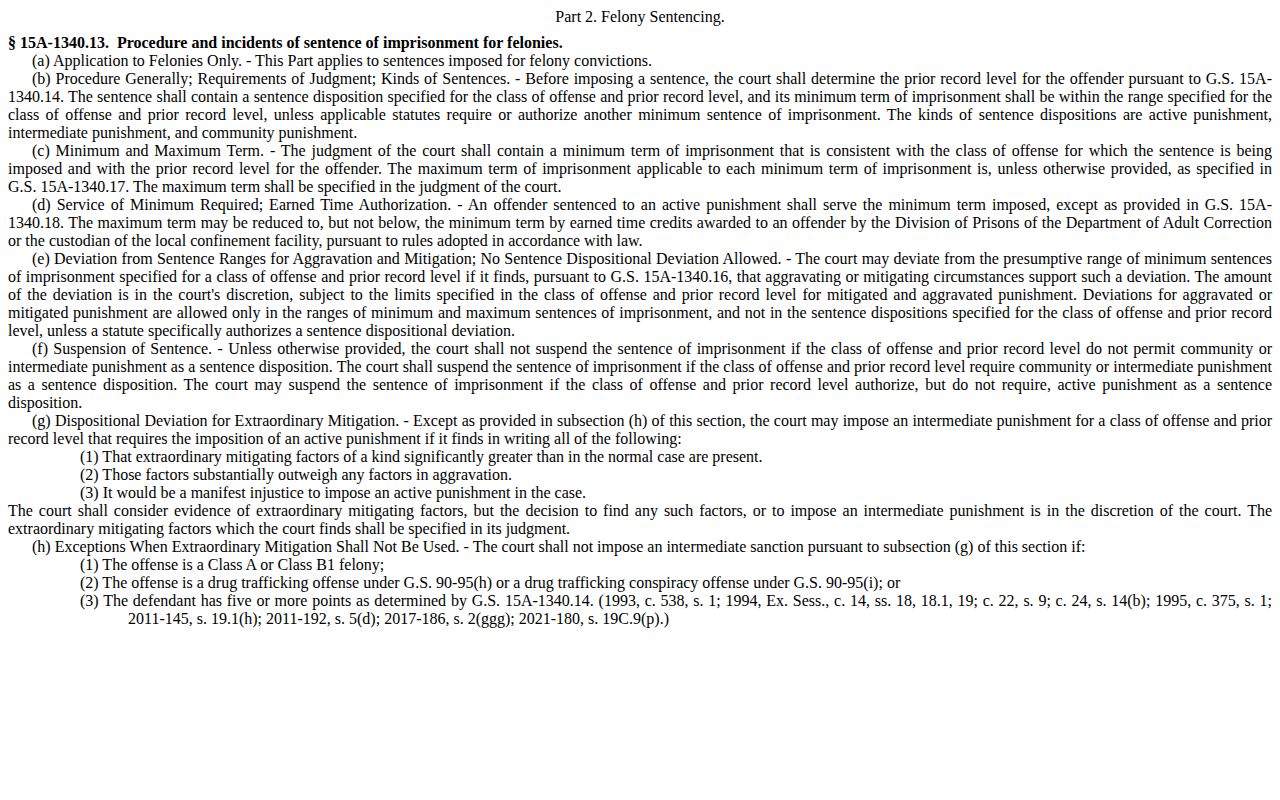
The statute sets a legal floor for the sentence calculation. It does not display an individual’s current date or confirm an actual release event.
Madison Earned-Time Release Credit
G.S. 148-13 authorizes NCDAC earned-time rules. Credit can affect the administrative projected release date, subject to the sentence law that applies. For a structured felony, G.S. 15A-1340.13 prevents earned credit from reducing the prison term below the court-imposed minimum. Presentence confinement credit under Article 19A can also count qualifying time already spent in custody.
Credits are not a flat promise. The NCDAC calculation can reflect credit earned, lost through discipline, or restored under applicable rules. Sentence corrections and court orders may change the starting data. Consecutive sentences run in sequence, while concurrent terms overlap as the judgment directs. These factors are why copying a sentence length from a court docket and counting calendar days can produce the wrong answer.
Release to post-release supervision adds another distinction. Under G.S. 15A-1368.2, many current felony sentences move from prison to a supervision phase through a calculation tied to maximum term, applicable supervision period, and earned time. Completion of that supervision, not the prison gate date, terminates the sentence under the statute.
Note: North Carolina earned time can change a projection, but it cannot be turned into one fixed percentage for every sentence.
Madison County Jail Release Math
A Madison County jail misdemeanor is not calculated with the felony post-release formula. G.S. 15A-1340.20 says an activated misdemeanor sentence is served day for day except for authorized work or earned credit, and caps the combined award described there at four days per month. G.S. 162-60 separately addresses local work-release credit.
The judgment supplies the active term and legal context. The jail’s calculation applies confinement credit and any authorized local credit. Ask for that calculation or the recorded release date rather than estimating from the sentence date. A “time served” judgment may recognize credit, but it does not replace the operational record of when Madison County custody ended.
County jail credit should be tied to the same booking and judgment. Time spent in another county or under another case may require a legal determination before it can be applied. The public docket can show the sentence and later orders, but Madison detention records are still needed for the actual local custody dates. When a result appears short or long, request the source calculation instead of assuming which credit was used.
No verified Madison policy supports a general weekend-release adjustment. Do not assume that the jail releases everyone early when a calculated date falls on a weekend or holiday. If timing matters, call 828-649-2721 for present custody and use the Sheriff’s written records process for the release calculation or past event.
Why Madison Release Dates Change
A projected release date is the output of facts and rules that can change. Some changes affect the calculation itself. Others do not move the date but change what happens when Madison County or NCDAC stops holding the person. A detainer, for example, can turn departure from one custodian into immediate transfer to another.
| Factor | Possible effect | Best confirmation |
|---|---|---|
| Earned-time gain or loss | Moves the administrative projection within the limits of governing law | Current NCDAC calculation |
| Presentence confinement credit | Counts qualifying time already served toward the sentence | Judgment and sentence calculation |
| Consecutive or concurrent terms | Changes whether sentence periods stack or overlap | Signed judgments and NCDAC history |
| Court correction or new order | Changes a term, credit, stay, or other controlling fact | Madison County court file |
| Discipline or credit restoration | Can delay or advance the current projected date | NCDAC record or custodian response |
| Detainer or receiving agency | May cause transfer after release from the first custodian | Release disposition and receiving-agency entry |
| Parole or supervision action | Can alter a legacy release plan or return a supervised person to custody | Commission action plus later OPI event |
A planned Mutual Agreement Parole Program date is another prospective milestone. It can be changed or ended. Commission eligibility or a favorable decision must be followed by an actual OPI incarceration event or agency record before it is described as physical release.
Madison Pretrial Release Timing
A pretrial detainee has no sentence-based projected release date. Madison County’s District 35 pretrial policy distinguishes unsecured bond, custody release, secured bond, and secured bond with electronic house arrest. The individual signed release order, not a suggested schedule, proves the actual condition. A later judge or magistrate action can also change the path.
The Sheriff record answers when Madison County Detention Center stopped holding the person and whether another agency received them. The court record explains the bond or release order. These records do different work. A pending court date after release is normal and does not mean the person remains jailed. A court order for an active term also does not prove the exact moment jail staff completed the release or transfer.
Note: A transfer ends Madison custody without proving community release, so ask whether the release record names another custodian.
Confirm Madison Actual Release
Use a later actual record to close the gap between projection and event. For NCDAC, read the incarceration history and current status after the projected date. The dedicated Inmate Releases search can show recent state releases associated with Madison, but it is state-prison data, not a Madison County jail list. An active supervision row means prison release occurred while correctional control continues.
For a local sentence, request the Sheriff’s booking and release record with the release date, time, disposition, and receiving agency. Pair it with the Madison County judgment when the legal reason matters. A phone call is useful for current custody, but the Sheriff’s policy makes the written process the formal records channel.
A pending custody alert through Madison County VINELink can report a later release or transfer event. Treat that notice as a prompt to verify, not as a certified release document. NC SAVAN can also send projected-date events, and those remain estimates until the source agency reports the actual change.
Dates copied long before the event can go stale. Save the exact label and source, check the record again, and ask the custodian when a past projection no longer matches the current history. That method preserves the difference between expected release, physical departure, transfer, supervision, and final discharge.
For state custody, the matched offender number helps NCDAC resolve the question. For a county sentence, give the Sheriff and Clerk the full name, case number when known, and the approximate custody period. A narrow request is easier to match to the correct Madison County episode and reduces the risk of mixing records for people with similar names.